
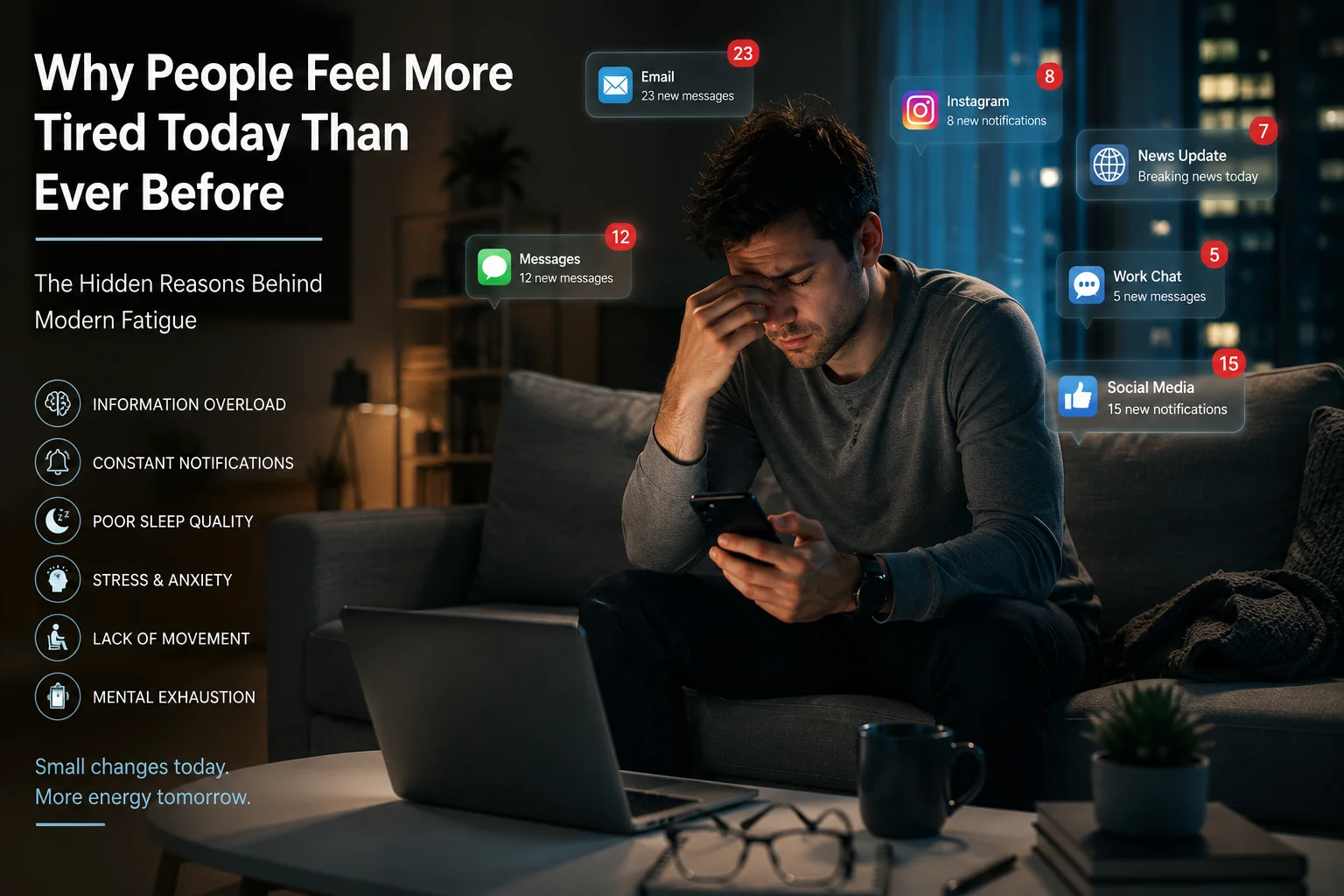
A strange pattern is happening around the world.
Millions of people wake up tired.
They sleep for seven or eight hours.
They are not doing physically exhausting labor.
Yet by midday, they already feel mentally drained.
By evening, many feel exhausted even though their bodies have done very little physical work.
So what is happening?
Why are so many people feeling tired today more than previous generations?
The answer is deeper than simply “not getting enough sleep.”
Modern life is quietly exhausting the human brain in ways many people do not fully realize.
We Are Processing More Information Than Ever Before
The human brain was never designed to process the amount of information people consume today.
Think about an average day.
Within a few hours, many people interact with:
- Social media notifications
- Emails
- News updates
- Video content
- Work messages
- Advertisements
- Online conversations
- Constant phone alerts
Even when the body is resting, the brain remains continuously active.
Mental overload creates a type of fatigue many people mistake for physical tiredness.
Decision Fatigue Is Draining Energy
Every day, people make hundreds of small decisions.
Examples include:
- What to wear
- What to eat
- Which emails to answer
- Which messages to reply to
- What content to watch
- Which tasks to prioritize
- How to spend free time
Every decision consumes mental energy.
Psychologists call this decision fatigue.
The more decisions people make throughout the day, the more mentally exhausted they become.
This is one reason people feel unusually tired despite doing little physical work.
Constant Screen Exposure Is Affecting the Brain
Modern life revolves around screens.
Phones.
Laptops.
Televisions.
Tablets.
The average person now spends several hours daily looking at digital screens.
Long-term screen exposure can contribute to:
- Eye strain
- Reduced focus
- Mental fatigue
- Sleep disruption
- Lower concentration
- Reduced creativity
Even entertainment can become mentally exhausting when the brain never truly disconnects.
Multitasking Is Creating Invisible Stress
Many people believe multitasking improves productivity.
In reality, the brain does not truly multitask well.
Instead, it rapidly switches attention between tasks.
Examples:
- Working while checking messages
- Watching videos while eating
- Replying to emails during meetings
- Scrolling social media while studying
Constant switching forces the brain to repeatedly refocus.
Over time, this creates mental exhaustion.
Poor Sleep Quality Is Becoming a Global Problem
Sleeping eight hours does not always mean quality rest.
Modern habits often damage sleep quality.
Common causes include:
- Using phones before bed
- Stress and overthinking
- Late-night caffeine
- Irregular sleep schedules
- Artificial light exposure
- Lack of physical movement during the day
Poor sleep quality affects:
- Mood
- Memory
- Focus
- Energy levels
- Immune system performance
Many people feel tired simply because their brains never fully recover overnight.
The Body Was Designed for Movement
One of the biggest contradictions of modern life is this:
People move less than ever.
Many spend entire days:
- Sitting at desks
- Driving
- Watching screens
- Staying indoors
Ironically, lack of movement often reduces energy.
Physical activity helps improve:
- Blood circulation
- Brain function
- Mood regulation
- Sleep quality
- Stress reduction
Sometimes people feel tired not because they are doing too much.
But because they are moving too little.
Mental Stress Never Truly Turns Off
In previous generations, work often ended when people left the workplace.
Today, work follows people everywhere.
Many people constantly think about:
- Career pressure
- Financial concerns
- Family responsibilities
- Social expectations
- Future uncertainty
Even during rest, the brain remains active.
Continuous mental tension slowly drains energy over time.
Why Quiet Time Has Become Rare
Modern life rarely allows true mental silence.
Most free moments are immediately filled with stimulation.
Examples:
Waiting in line → checking phone.
Sitting alone → opening social media.
Short break → watching videos.
The brain rarely gets uninterrupted quiet time.
Without mental recovery, fatigue accumulates.
How to Restore Mental Energy
Small changes often make a big difference.
Helpful habits include:
- Spending time away from screens
- Walking daily
- Improving sleep quality
- Limiting unnecessary notifications
- Taking short breaks during work
- Reducing multitasking
- Creating quiet time without digital stimulation
- Spending time outdoors
The goal is not doing less.
The goal is allowing the brain to recover properly.
Final Thoughts
Many people believe tiredness comes only from physical effort.
But modern exhaustion is often mental, not physical.
Constant information, digital overload, poor sleep quality, endless decision-making, and nonstop stimulation are quietly draining energy worldwide.
The body may be resting.
But the brain often never stops working.
Understanding this is the first step toward building a healthier and more balanced life.
Sometimes the problem is not that you need more sleep.
Sometimes your mind simply needs more recovery.




Join The Discussion