
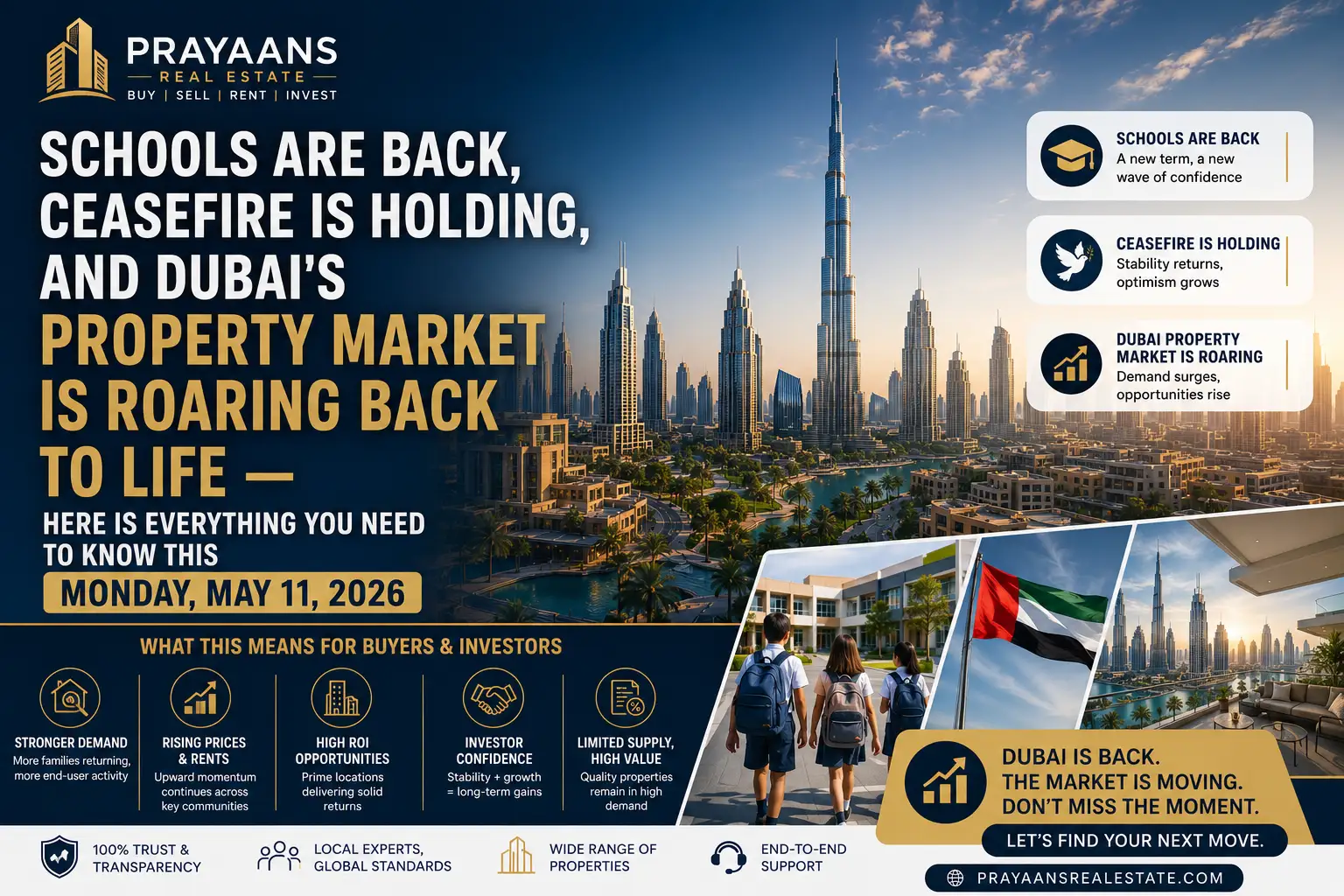
This Monday morning feels different. Schools across the UAE are open again. The ceasefire is holding. Oil prices have stabilised. And Dubai’s property market — which refused to collapse even during one of the most intense regional geopolitical crises in a generation — is not just recovering. It is accelerating.
If you have been sitting on the sidelines watching the headlines and wondering whether now is the right moment to buy, invest, or even just pick up the phone — read this first. Because what the data is telling us today, Monday May 11, 2026, is more compelling than anything we have seen in the past six months.
At Prayaans Real Estate LLC, Dubai-registered and headquartered in the heart of this market, we track every signal — the institutional moves, the DLD daily numbers, the developer launches, and the macro shifts — so we can give you the clearest possible picture. Here is today’s full picture.
The Moment We Are In: Normalcy Returns to the UAE Today
This morning, the UAE Ministry of Education confirmed that in-person learning resumes across the country from Monday, May 11 — covering all public and private schools, nurseries, and universities following the period of disruption linked to regional developments. Students, teachers, and staff are back in classrooms.
It sounds like a simple education story. But for property professionals, the reopening of schools is one of the most meaningful signals a market can send. Why? Because families do not buy homes or sign long leases in cities where schools are closed and normalcy is uncertain. The return to classrooms is the UAE’s clearest institutional signal yet that the storm has passed and life — business, investment, family decisions — resumes in full.
For buyers who have been waiting for exactly this kind of clarity: today is that day.
The Ceasefire Effect: What It Did to the Dubai Property Market in Real Time
Let us go back and understand what happened — and what it tells us about what comes next.
When the US-Iran ceasefire brokered by Pakistan was announced in early April 2026, ending over five weeks of one of the most disruptive geopolitical conflicts the Middle East has seen in years, the response in Dubai’s property market was immediate and dramatic.
Dubai’s main stock index surged 6.9% following the ceasefire announcement. Major property developers recorded share gains of up to 13% in the days that followed. Equity markets in real estate are leading indicators — they move before property transaction volumes do. What the stock market was telling us in April, the DLD transaction data is confirming in May.
At Sobha Realty, Managing Director Francis Alfred said that customer conversions increased threefold immediately after the ceasefire compared to the conflict period. “People who were waiting on the sidelines are beginning to return. International buyers are also coming back,” he confirmed. “The UAE property market is now far more mature and resilient. It is not jumping up and down because of short-term events.”
This is the defining characteristic of Dubai’s market in 2026: it is not a market of panic or speculation — it is a market of conviction. Institutional capital kept flowing through the conflict. Record Q1 numbers were posted despite the crisis. And now, with stability returning, the pent-up demand that was paused is being released.
The Numbers That Define This Market Right Now
Q1 2026: The Most Successful Quarter in Dubai Property History
The Dubai Land Department released the definitive Q1 2026 scorecard, and it rewrote the record books entirely:
- Total transaction value: AED 252 billion — up a staggering 31% year-on-year
- Total transaction volume: 60,303 deals — up 6% on Q1 2025
- Foreign investment: AED 148.35 billion — up 26% year-on-year, from non-UAE buyers
- Foreign transactions: 48,445 deals — up 11% year-on-year
- New investors entering the Dubai market in Q1 alone: 29,000+
As Fibha Ahmed, VP of Property Sales at Bayut and dubizzle, put it: “Dubai’s property market is increasingly driven by informed participants who prioritise data over impulse. What we are seeing is a rational market that has just come off its most successful quarter in history.”
And Mohamed Alabbar, founder of Emaar — the developer behind Downtown Dubai, Dubai Hills, and dozens of the emirate’s iconic communities — added: “Recent geopolitical developments in the region have reinforced the importance of operating in markets defined by safety, institutional continuity, and long-term vision. The UAE’s stability is the result of decades of wise leadership, sustained investment in world-class infrastructure, and a clear, business-friendly policy environment.”
These are not marketing statements. These are the words of a man overseeing one of the most valuable real estate development businesses on earth — and he is more bullish than ever.
April 2026 Rebounds Hard After March’s Geopolitical Shock
The most recent market review confirms what the DLD daily data has been signalling: Dubai’s property market rebounded sharply in April after March’s disruption, proving that liquidity — the ability to buy and sell quickly — remains fully intact even during a regional crisis.
On a single day in early May, the market recorded AED 2.39 billion in transactions, with off-plan dominating at 78.4% of total value (AED 1.88 billion). The headline story of that single day: Lumena by Omniyat contributed AED 1.02 billion in off-plan office sales alone — more than half of the day’s entire off-plan activity. The off-plan office market has now posted its highest monthly transaction value on record: AED 3 billion in April, according to Al Masdar Al Aqaari analysis of DLD data.
The Hottest Story in Dubai Property This Week: City Tower Launches on Sheikh Zayed Road
The brand-new launch making waves right now is City Tower — a landmark 93-storey long-term leasing project on Sheikh Zayed Road, jointly launched by Betterhomes and H&H Properties. Offering 695 residences from June 2026, City Tower is designed for residents who want central connectivity — within reach of DIFC, Downtown Dubai, Jumeirah, and the Emirates Towers Metro.
This is significant for several reasons. First, a 93-storey residential tower launching on Sheikh Zayed Road in the middle of a post-conflict recovery period is a statement of supreme developer confidence in Dubai’s long-term appeal. Second, it targets the growing segment of residents who want premium rental living in the heart of the city — a segment that has been undersupplied on Sheikh Zayed Road for years. Third, with 695 units coming online from June 2026, it creates a new benchmark for what central Dubai living looks like.
For investors, the question is not whether City Tower will fill up — it is whether you are getting in before or after the rental market reprices around it.
The Bifurcated Market: What Is Performing and What Is Pausing
Here is the honest picture that the data reveals this week — and it is nuanced.
Dubai is not one market. It is a collection of micro-markets performing very differently, and understanding the split is the difference between a smart investment and an average one.
What is surging:
- Off-plan remains dominant, accounting for 57% of residential transactions by volume in Q1 2026
- Ultra-prime and branded residences are structurally undersupplied and attracting global HNWI capital
- Off-plan office space hit a record AED 3 billion in April — Grade A office demand has pushed average prices to AED 3,047 per sq ft
- Villa and townhouse prices are growing at 12–18% annually, far outpacing mid-market apartments
- Dubai Islands has led off-plan sales for four consecutive months with AED 7.9 billion year-to-date
- JVC is delivering gross rental yields of up to 8.5%
What is stabilising:
- Mid-market apartment pricing has seen a modest 3.8% quarterly contraction per the ValuStrat Price Index — the first since 2020, and viewed as healthy stabilisation, not a crash
- Ready home transaction values have cooled slightly as more listings enter the market
- Rental pricing in some mid-market segments has softened, with average annual rents declining from their January peak — giving tenants more negotiating power than they have had in years
The bottom line: The market is becoming more selective, not weaker. As Firas Al Msaddi, CEO of fäm Properties, said: “The winners in 2026 will not be defined by hype. They will be defined by data, fundamentals, infrastructure and brand credibility.”
Where Is the Smart Money Going in May 2026?
1. Off-Plan Offices — The Biggest Surprise Opportunity
Most investors focus on residential. The commercial story is the one they are missing. April’s record AED 3 billion in off-plan office transactions reflects a structural undersupply of Grade A office space in Dubai that has persisted for years. Corporate expansion, DIFC growth, and the influx of international firms establishing UAE headquarters are creating sustained demand that the office market has not been able to satisfy. For investors seeking yield diversification beyond apartments, off-plan offices in DIFC, Business Bay, and City Walk deserve serious attention.
2. Dubai Hills — Institutional-Endorsed, Fundamentals-Backed
With Brookfield Asset Management’s 480,000 sq ft mixed-use development now officially confirmed at Dubai Hills, the area has received the strongest possible institutional endorsement. Villa and townhouse prices here are growing 12–18% annually. End-user demand is deep. And the Brookfield development will add a new layer of lifestyle amenity that will lift valuations across the entire community. This is where quality compounds.
3. Sheikh Zayed Road — The Central Living Revival
City Tower’s launch signals a renewed developer conviction in Sheikh Zayed Road as a residential destination. For investors targeting yield from central Dubai rentals — young professionals, corporate executives, short-term business visitors — this corridor is regaining momentum. Watch this space closely through Q2 and Q3.
4. Dubai Islands — Four Months at the Top for a Reason
Four consecutive months as Dubai’s #1 off-plan sales destination is not luck — it is infrastructure, waterfront positioning, government backing, and a master plan that gives buyers confidence. AED 7.9 billion in year-to-date sales confirms deep and sustained demand. Early-phase buyers are already sitting on meaningful capital gains.
5. JVC and Arjan — The Affordable Yield Champions
For investors under AED 1 million, JVC remains the market’s most consistent performer. Gross yields of up to 8.5%, strong tenant absorption, and a growing community ecosystem make it the UAE’s most reliable mid-market buy-to-let play. The visa reform removing the AED 750,000 floor means JVC buyers can now access UAE residency from their investment — a game-changer for affordability-focused international buyers.
5 Things Every Buyer Should Do This Week
1. Move Before the Post-Ceasefire Surge Fully Prices In
The data is clear: buyers who act during and immediately after periods of uncertainty consistently outperform those who wait for the all-clear. With schools open, the ceasefire holding, and Q1 numbers rewriting records, the “uncertainty discount” that briefly existed in March is evaporating. The window is closing.
2. Ask Your Agent About the New Visa Rules — Before You Choose a Budget
The scrapping of the AED 750,000 minimum for the two-year investor visa means your budget decision is now also a residency decision. A AED 600,000 studio in JVC can anchor your UAE residency. Understand the full framework before you set your price ceiling.
3. Look Seriously at Villas and Townhouses
With 12–18% annual price growth versus 5–10% for mid-market apartments, the villa and townhouse segment is outperforming. If your budget reaches AED 1.5 million to AED 3 million, a townhouse in Reportage Bianca Dubailand, DAMAC Lagoons, or NSHAMA’s communities deserves to be on your shortlist.
4. Consider the Commercial Angle
If you have AED 800,000 to AED 2 million to invest and want to diversify beyond residential, the off-plan office market’s record performance in April is a signal worth heeding. Average Grade A office prices at AED 3,047 per sq ft are still below comparable markets in Singapore and London — and Dubai’s corporate growth trajectory is significantly stronger.
5. Register Your Tenancy — Every Tenant Should Have an Ejari
With schools resuming and normalcy returning, the rental market is going to tighten again heading into October–November. If you are a tenant, make sure your Ejari registration is current and your renewal rights are protected. If you are a landlord, this is the moment to review your rental pricing strategy — not to hold out for peak pricing, but to fill the low-season window before competition increases.
A Note on the Bigger Picture
Dubai has now been stress-tested by something it has not faced in this magnitude in years — a regional conflict that disrupted schooling, rattled global sentiment, and paused some buying decisions. And the result? Q1 2026 was the most successful quarter in the market’s history. Foreign investment rose 26%. New investors grew by 29,000 in a single quarter. And on the day schools close and the ceasefire is announced, the DLD registers AED 2.39 billion in a single day’s transactions.
This is what a mature, fundamentals-driven market looks like under pressure. It does not collapse. It absorbs. And then it advances.
Dubai is not the market it was in 2012, or 2020, or even 2023. It is something more stable, more institutional, and more globally integrated than it has ever been. The people buying here today are not speculators. They are builders — of wealth, of family lives, of business futures.
At Prayaans Real Estate LLC, we are here to help you build yours.
Talk to Us Today
The best property decisions are not made in panic or in euphoria. They are made with the right information, at the right time, with the right guide. That is what we offer.
📞 WhatsApp: +971 52 996 8602 🌐 Website: prayaansrealestate.com 📍 Head Office: Dubai, UAE


Join The Discussion